
Let it be noted that Benedict Arnold claimed many times leading up to his betrayal that he felt overlooked by the Continental Army concerning promotion. He felt as though his rank was not equal to the service that he had provided for his country. Now, General Benedict Arnold had demonstrated tremendous courage and intelligence during the conflicts at Fort Ticonderoga, Quebec, Valcour Island, and Saratoga, to name a few. And he had been hailed a hero by his country for each of those occasions. But fame and praise were not enough for this young general. He believed his country owed him more.
In 1779, Benedict Arnold married a woman, Peggy Shippen, from a Loyalist Philadelphia family. Many credit Arnold’s marriage to Peggy for his betrayal. It was known that Peggy was a friend of John Andre, a Major in the British Army. And John Andre is the man whom Arnold began secretly communicating with about his plans to defect. Peggy was their liaison.
There is a name in American history that has become synonymous with the term “traitor” and that is the name “Benedict Arnold”.
Time Travelers, today we travel back to September 21, exactly 246 years ago today. For it was on this day Benedict Arnold exercised his first act of betrayal against his country. His fellow countrymen and brothers-in-arms would soon discover that he had willingly abandoned his position of authority in the Continental Army and discarded the great regard and trust George Washington had for him, all in exchange for money and high rank in the British Army.
When the war began, Benedict Arnold was a respected merchant in the Atlantic. Like many young men, he joined the growing Continental Army to support the cause of freedom. Over his years of service and through many acts of courage, he had risen to the rank of Major General by the year 1777.
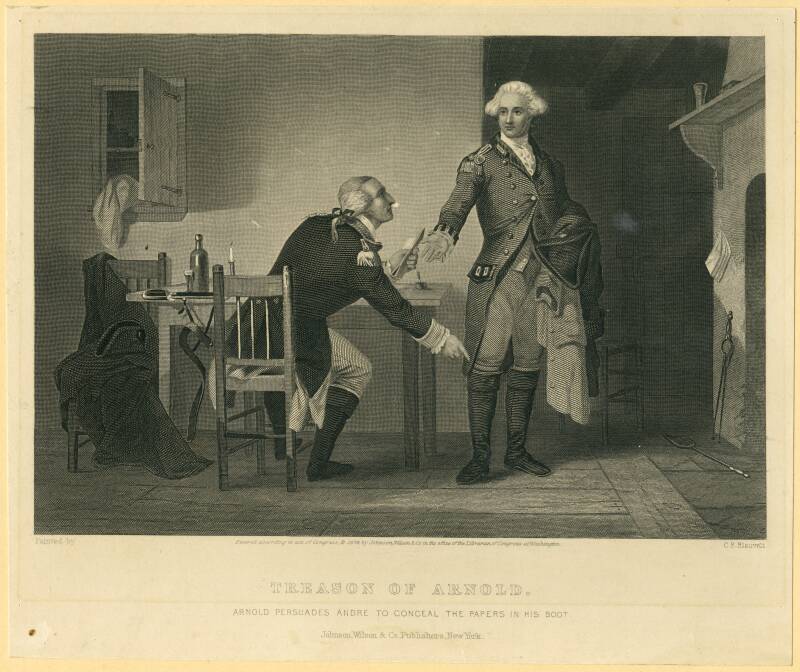
George Washington, who was ignorant of Arnold's unfaithfulness, gave him command of West Point in July of 1780. Westpoint was a major stronghold for the Continental Army, and Washington’s confidence in Arnold was so unwavering that he entrusted him with its protection. The British extended an offer of £20,000 to Benedict Arnold if he were to surrender West Point to their army, to which he agreed.
As if the £20,000 was not enough, Benedict Arnold was growing increasingly greedy for more and more favor from the British, so he began to stock the fort with provisions, and make repairs on it in order to win their favor. He even tried to further their debt to him by inquiring from George Washington the names and addresses of the patriots in Washington’s secret Culper Spy Ring. Washington denied this request.
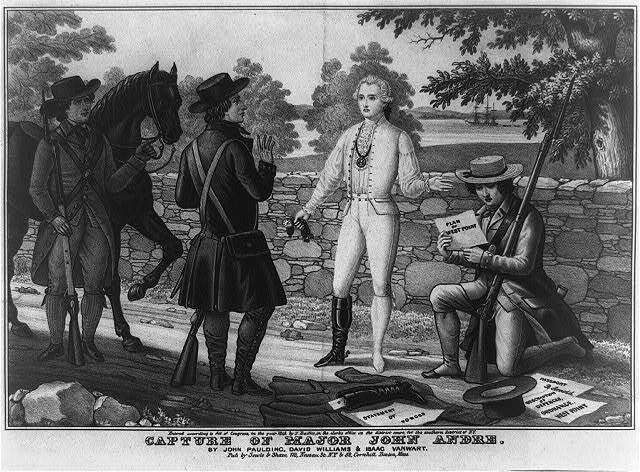
On the eve of September 21st, Benedict Arnold handed over important information about West Point to Major John Andre. Andre, disguised in civilian clothes, began to make his way back to British lines, carrying this intelligence with him in his boot, as well as a pass from Benedict Arnold. Two days into his journey, Andre was stopped and searched by several American militiamen. They searched him and forced him to remove his boots where they found both the pass from Arnold and 6 papers containing plans on how to take West Point.
When Colonel John Jameson of the Continental Army received these papers, he assumed that this was a plot by the British to bring about Benedict Arnold’s downfall. It seemed obvious they were trying to raise suspicion over Arnold’s loyalties. Yet, Jameson’s confidence in Arnold was unshaken. Instead of becoming suspicious, he sent a letter to Benedict Arnold apologizing for the slur upon his respectable name.
This was all Benedict Arnold needed. Their plans had been discovered, and he must make his escape. He boarded the HMS Vulture, an apt name for a traitor and promised the loyal oarsman of this vessel two gallons of rum if they would speedily row him to shore. When they reached shore, these men were informed that they were now prisoners of the British army. Benedict Arnold left behind his wife and child, trusting that the honorable Washington would treat them well. He would later request safe passage for them both to join him in England.
Benedict Arnold fought for the British for the remainder of the American Revolution and led troops on the march to burn both Richmond, Virginia and New London, Connecticut.
Andre was hanged for his involvement in this coup, but he died with great dignity, respected by those that brought him to trial.
Andre’s last letter was sent to Henry Clinton:
“I am perfectly and tranquil in mind and prepared for any fate to which an honest zeal for my King’s Service may have devoted me. In addressing myself to your excellency on this occasion, the force of all my obligations to you and of the attachment and gratitude I bear you, recurs to me. With all the warmth of my heart I give you thanks for your Excellency's profuse kindness to me, and I send you the most earnest wishes for your welfare which a faithful affectionate and respectful attendant can frame. I have a mother and three sisters to whom the value of my commission would be an object as the loss of Granada has much affected their income. It is needless to be more explicit on this subject; I am persuaded of your Excellency's goodness. I receive the greatest attention from his Excellency General Washington and from every person under whose charge I happened to be placed. I have the honor to be with the most respectful attachment."
Your Excellencies most obedient and most humble Servant
John André Adj Gen
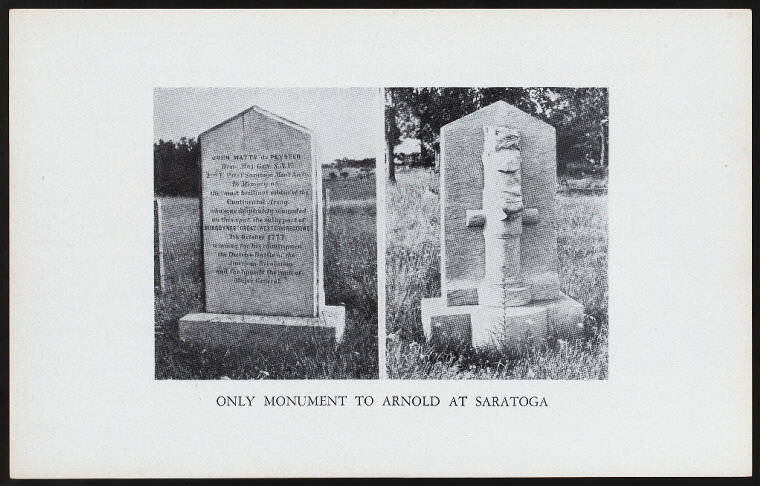
John Andre died in the service of his country while Benedict Arnold lived both a traitor and a coward.
Contrast this coward with a young schoolteacher who, only 4 years earlier, had given his life in service to his country. He gave up his career during Washington’s moment of need in order to infiltrate British occupied New York and gather information for Washington. He was caught and hanged two weeks later and was known to have said that his only regret was that he had but one life to lose for his country.
Benedict Arnold died in England in 1801, loved by neither his fellow countrymen nor by those that he claimed to serve with secret intelligence.
Add comment
Comments