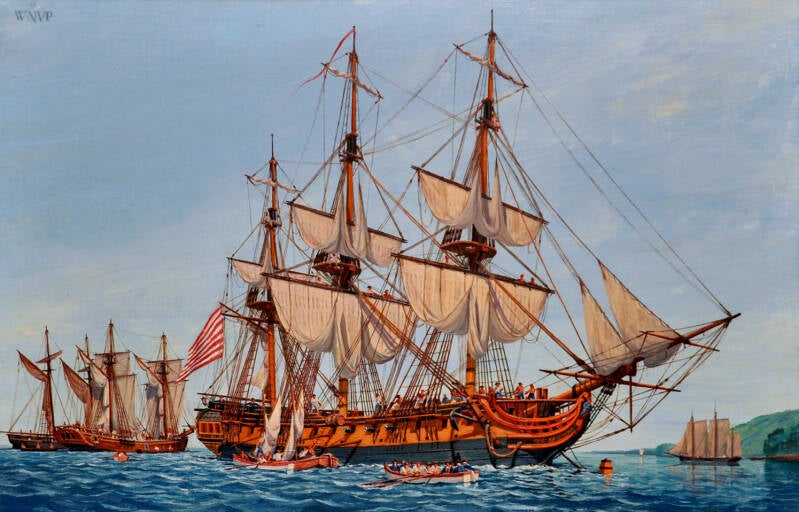
250 years ago, the Continental Navy was formed.
America was up against one of the greatest empires in the world, the British Empire, facing one of the largest and most powerful naval forces. The Continental Congress had encouraged individual colonies to organize naval defenses, but no plans had been made for a united Continental Navy.
Rhode Island was among the earliest advocates for a continental fleet. In August of 1775, it proposed an important step toward establishing one. Samuel Chase, a Maryland delegate scoffed at the idea, claiming that it was, "the maddest idea in the world." Many thought the idea of a Continental Navy to be “the most wild, visionary, mad project that had ever been imagined."
George Washington disagreed. He believed, “It follows then as certain as that night succeeds the day, that without a decisive naval force we can do nothing definitive, and with it, everything honorable and glorious.” Without waiting for Congress to establish a navy, he used his authority as Commander-in-Chief to organize an independent naval force. He purchased a small vessel called the Hannah. She was run ashore during her first month of service after an encounter with a British ship.
In 1774, Britain had closed off Boston's port with the Boston Port Act. Parliament then appointed General Thomas Gage as military governor in Massachusetts. He declared martial law on the colony in June of 1775. In October of 1775, Congress received intelligence that British powder ships were headed for Quebec. This confirmed their need for a united naval force.
On October 13, 1775, the Continental Congress authorized the construction of the first Continental naval force. The Continental Navy was intended to:
- Protect American trade
- Intercept British supply ships to supply the Continental Army with much-needed provisions.
The first Continental Navy was formed from a fleet of merchant ships and whaleboats transformed into American navy vessels. As time progressed, the Continental Congress saw the need for a more formal fleet of purpose-built warships. On December 13, 1775, Congress authorized thirteen frigates: five carrying 32 guns, five carrying 28 guns, and three carrying 24 guns. Among the first vessels acquired for the Continental Navy were the Andrew Doria and the Cabot, two 14-gun brigs, along with the larger ships Alfred and Columbus. The Navy also acquired smaller vessels, including the schooners Hornet, Wasp, and Fly.
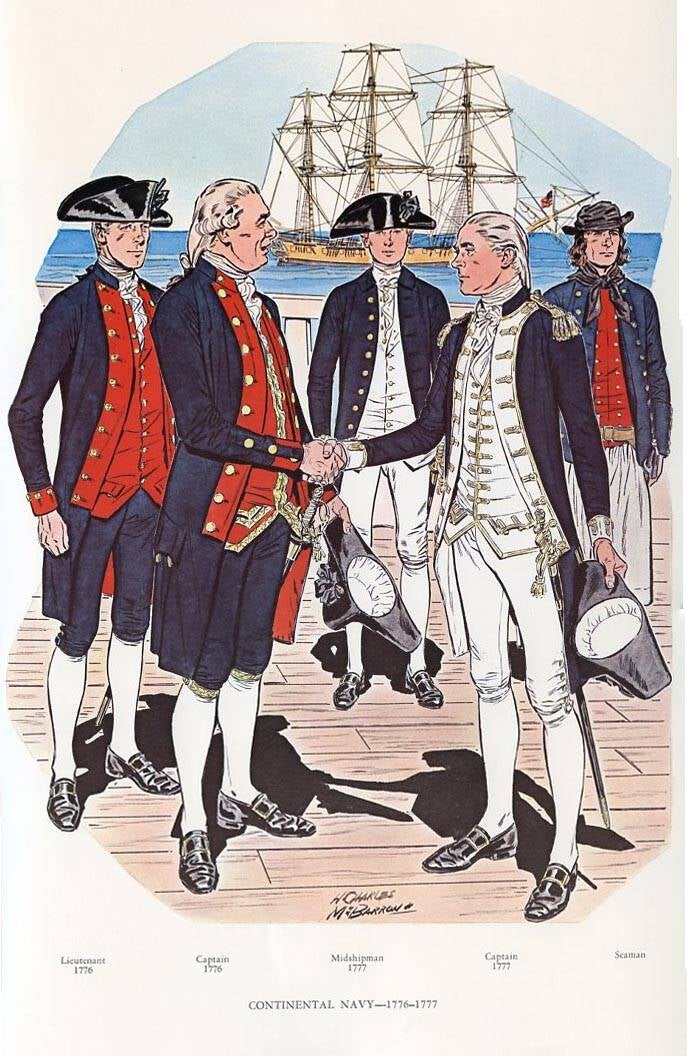
It was at this time that George Washington informed Congress that he had already taken the first steps in acquiring a small flotilla of fishing schooners to repurpose as war vessels. One month later, Congress agreed to create two battalions of soldiers to serve in the Continental Navy. John Adams helped develop the first rulebook for the Continental Navy.
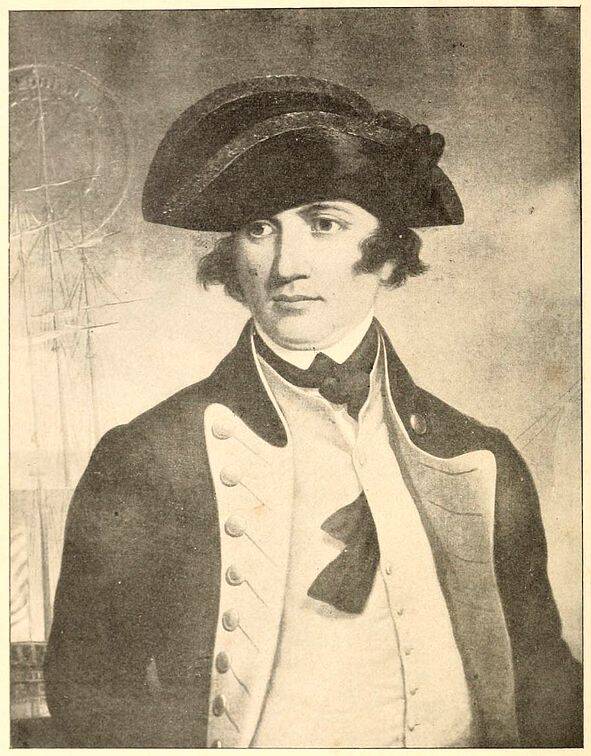
Esek Hopkins was appointed the first commander-in-chief of the Continental Navy, and four men were appointed captains: Dudley Saltonstall, Abraham Whipple, Nicholas Biddle and John Burroughs Hopkins.
Many Patriot leaders doubted the Continental Navy’s ability to stand up against the mighty British Royal Navy. Eventually, the colonies began to rally together to help the efforts of the Continental Navy. Virginia purchased land to build Navy supplies and farmers increased flax production to provide material for sails.
Privateers were privately owned ships, separate from the Navy, whose captain and crew were authorized by the government to capture enemy ships. Congress issued over 1,000 letters of marque, an official document issued by Congress that gave privateers permission to capture enemy ships and cargo. Without this document, attacking and taking another ship could be considered piracy. The privateers were successful in capturing over 2,000 British ships throughout the war, causing substantial financial losses for Britain.
Esek Hopkins led an expedition to Nassau in the Bahamas in March of 1776, capturing a supply of artillery and gunpowder for the Continental Army.
Benedict Arnold helped organize and build a fleet on Lake Champlain. He planned to use this fleet to slow down the Royal Navy from invading New York. Although Benedict Arnold suffered the loss of his fleet during the Battle of Valcour Island and the subsequent retreat, he managed to delay the British campaign and slowed their advance.
Although the Continental Navy never fought a major fleet action against the British Royal Navy, they did engage British warships and were successful in winning several victories over British warships. The Continental Navy disbanded at the conclusion of the war.
Add comment
Comments